
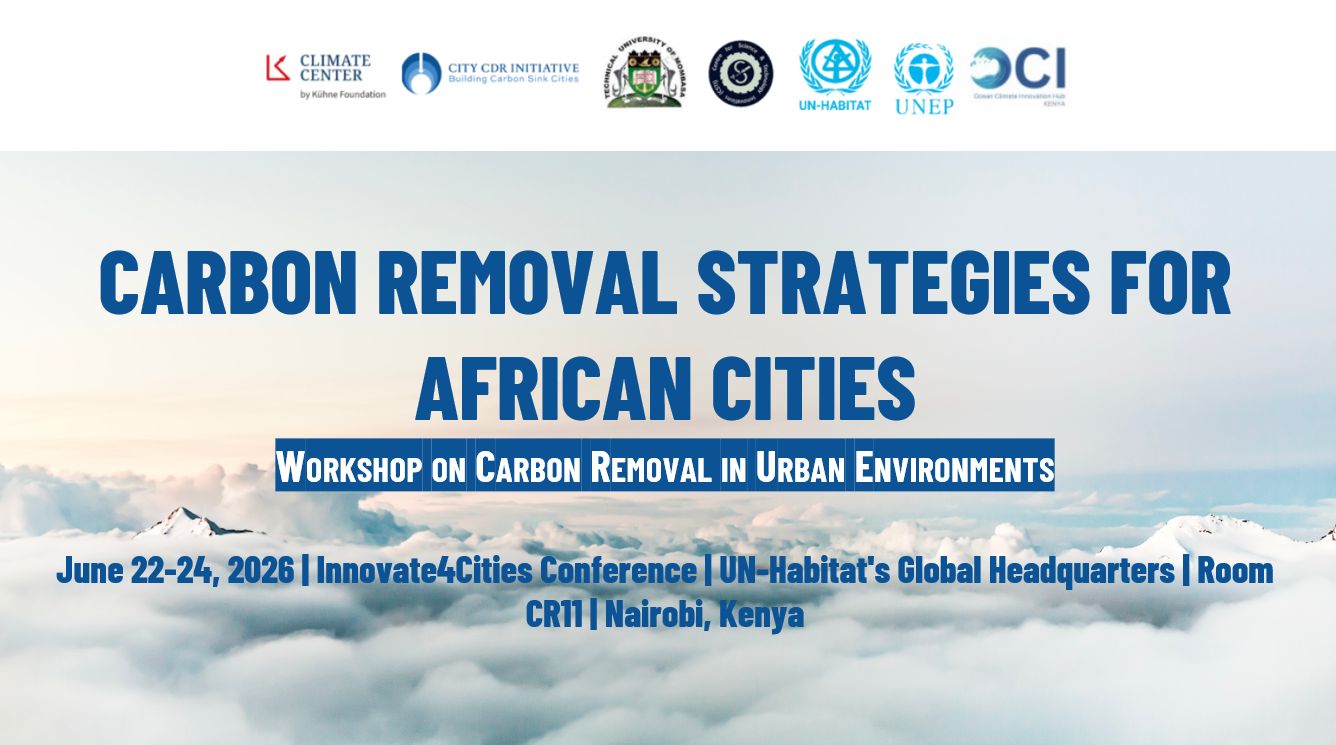
Carbon Removal Strategies for African Cities: Workshop on Carbon Removal in Urban Environments – 22-24/6/2026
On June 22-24, the City CDR Initiative organized a closed-door workshop for local governments in Africa on CDR strategies at the Innovate4Cities Conference in Nairobi. The workshop was held in collaboration with the Kuehne Climate Center, Centre for Science and Technology Innovations (CSTI), Technical University of Mombasa, Ocean-Climate Innovation Hub Kenya, UN Environment Programme and UN-Habitat (United Nations Human Settlements Programme).
The workshop is part of a targeted capacity building effort. It aimed to equip government officials with the knowledge and tools to engage other departments and decision makers on the needs and approaches to CDR planning locally. There were government representatives from Nairobi, Mombasa and Kisumu (Kenya), Lagos (Nigeria), Walvis Bay (Namibia), Accra (Ghana), Dar es Salam and Zanzibar (Tanzania), eThekwini/Durban and Mangaung (South Africa), Quelimane (Mozambique), and virtual participation from Kampala ((Uganda). They form the core of a new pan-African collaboration of local governments on urban CDR.
What did we explore? How to position CDR solutions as a systems upgrade, instead of a peripheral climate extra. How ‘challenge-led CDR’ portfolios can improve public service delivery in waste, energy, adaptation, and pollution. How to integrate CDR across urban environments, systems and infrastructures, and institutional frameworks (governance, policy, budgets). How to anchor carbon removal strategies in African innovation and indigenous practices.
Three keynote interventions set the stage:
- Global temperature overshoot is now inevitable. Professor Debra Roberts, coordinating lead author on the IPCC Special Report, framed CDR as the critical tool to prevent irreversible change. She called for revolutionary thinking on what cities should do and how they should look.
- Local governments are not alone though. I was heartened by the words from Rafael Tuts, Director Global Solutions at UN-Habitat (United Nations Human Settlements Programme) who said that CDR is not peripheral, but should be integrated in the organization’s Catalogue of 81 Climate Solutions.
- Niklas Hagelberg, Senior Coordinator for Climate Change at the UN Environment Programme, issued a call to action: “Wherever materials are used, there is a chance for CDR… But it’s not an opportunity that will just materialize. We need to try out policies, measure impact, and adapt design”.
The workshop had the following take-aways:
- Lean into homegrown innovation, solutions and infrastructure AND complement this with stuff from abroad.
- Design urban CDR in line with national frameworks AND leverage local action to nudge national ambition.
- Use Integrated Development Plans (IDP) to mainstream urban CDR AND experiment with small tangible interventions.
- Refine how we look for funding, define impact metrics in line with local needs AND diversify the funding base as a priority.
- Make communities project custodians AND build skills along the entire carbon removal value chain and logistics system.
- Leverage CDR to transform public utilities from a cost center into an investment platform.
Where do we go next? This workshop was just the beginning. CityCDR will now work with our partners and the cities to develop an African model for public interventions at the local level. This comes in the form of a regionally tailored Roadmap for City CDR Strategy Development. CityCDR will continue to provide a platform for ongoing exchange, learning and capacity building.
