Tools & Resources
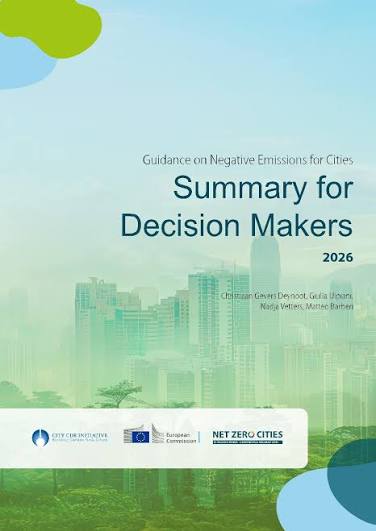
Guidance on Negative Emissions for Cities: Summary for Decision Makers (2026)
The European Commission’s Joint Research Centre (JRC) recently published its Guidance on Negative Emissions for Cities. CityCDR was a co-author on the Guidance and lead author on the Summary for Decision Makers. This document provides city decision-makers and practitioners with a concise and accessible roadmap for developing robust and high-integrity residual emissions strategies. It outlines key decision-making points, step-by-step operational approaches, and best practices for cities to advance negative emissions, leveraging carbon removal opportunities and avoiding common pitfalls.
Some highlights of what is included:
– Residual emissions calculation methodology
– Overview of urban CDR opportunities and challenges
– Guiding principles for carbon removal planning
– Recommendations on CDR accounting and claiming
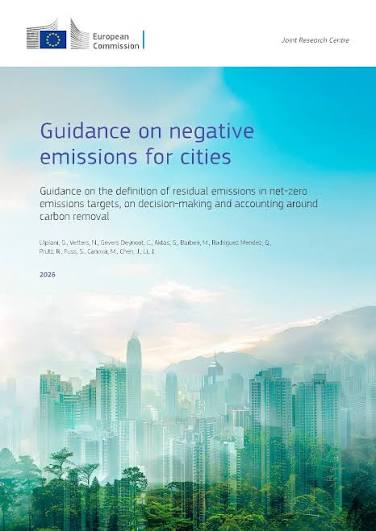
Guidance on Negative Emissions for Cities (2026)
The European Commission’s Joint Research Centre (JRC) published a world-first in-depth Guidance on Negative Emissions for Cities that was co-authored by the City CDR Initiative. This is the essential guide for policymakers, city leaders, decision-makers and urban practitioners on residual emissions planning and carbon removal compensation strategies. The Guidance primarily addresses cities involved in the EU’s 100 Climate-Neutral and Smart Cities Mission, but it can be used as a conceptual and practical reference by any city targeting net-zero emissions. The main objectives are to offer precise directions for negative emissions strategies and accounting, distill key principles and create a conceptual framework around the use of emissions compensation mechanisms (local carbon removals and carbon credits). The focus is on guaranteeing high climate and environmental integrity, managed through a transparent and ethical process, aligned with international best practices.
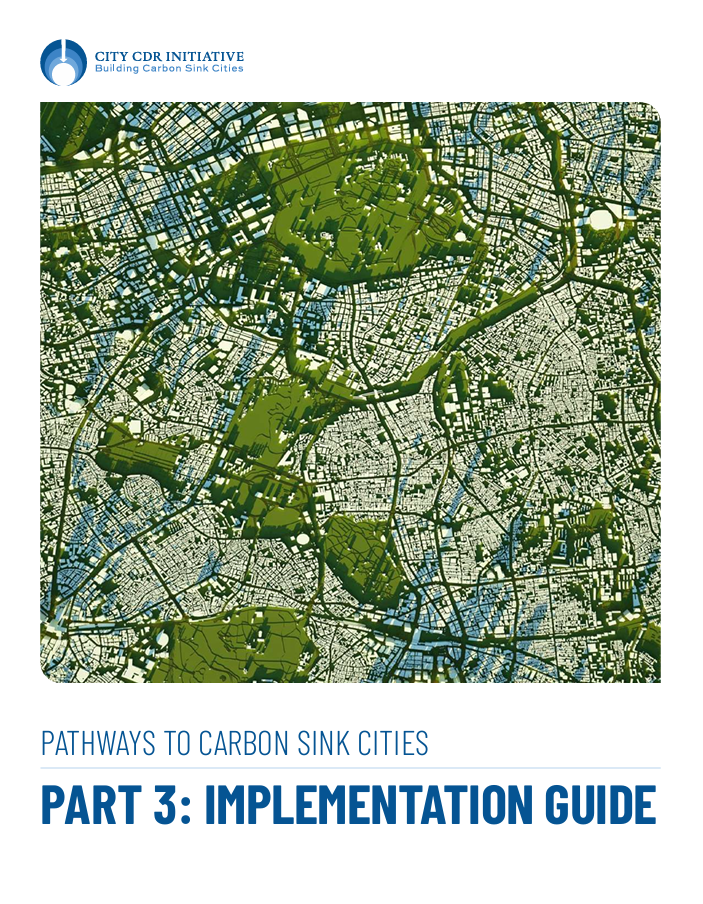
Pathways to Carbon Sink Cities: Implementation Guide (2025)
Pathways to Carbon Sink Cities: Implementation Guide (Part 3), is the third and final report in a three-part series under the City CDR Initiative’s urban CDR opportunity baselining assessment. This Guide gives local officials the practical tools to act: frameworks, processes and methods that cities can use immediately, even at early stages of readiness. Together, the Carbon Sink Cities series offer a clear narrative and actionable roadmap to local governments wanting to increase the ambition of their climate action efforts. By applying and iterating on these tools – and by learning collectively – cities can bring about a future in which CDR supports local development goals, fosters regenerative models, strengthens resilience and contributes meaningfully to global climate stability.
Pathways to Carbon Sink Cities: Need-Gap Analysis (2025)
Pathways to Carbon Sink Cities: Need-Gap Analysis (Part 2), is the second report in a three-part series under the opportunity baselining assessment. It builds on the Vision Paper (Part 1) and sets the stage for the Implementation Guide (Part 3). The Need-Gap Analysis investigates the urban CDR landscape, highlighting the many opportunities that come with embedding CDR in urban systems, infrastructure, policies and governance, and identifying the challenges and solutions to unlocking urban CDR at scale. In the process, the report reframes the power local governments have to transform urban environments and realize carbon sink ubiquity.
Pathways to Carbon Sink Cities: Vision Document (2025)
This Vision Paper is the first in a three-part report series on pathways to Carbon Sink Cities. It is intended as a discussion starter on how to design the future of our cities in the climate crisis era by integrating carbon sinks in the urban environment. The Vision Paper gives some pointers on potential public interventions, but does not aspire to provide a conceptual or policy framework. Further work is needed to define the pathways for implementation, rooted in sound economic and financial data, with detailed technical definitions, and practical case studies. Part 2 is a Need-Gap Analysis and Part 3 an Implementation Guide for city officials.
Pathways to Net-Zero Cities: The Role of Cities in Advancing Carbon Removal (2024)
This report explores the opportunities and challenges connected to City CDR and describes the different pathways of engagement for cities. It was developed as a guide and reference for cities to understand how carbon removal can play an integral role in achieving net-zero strategies. The report was prepared by three consortium partners (XPRIZE, South Pole and the Global Carbon Removal Partnership) before the formal launch of the City CDR Initiative.
Quick Scan on the Carbon Removal Potential in the Amsterdam Metropolitan Area and the North Sea Canal Area (2022)
This report summarizes the general role of CDR in climate action, provides an assessment of various processes relevant to the removal of CO₂ from the atmosphere and indicates the potential of CDR deployment in the Amsterdam area in 2030 and 2050. The report was commissioned by the City of Amsterdam to two consortium partners (Bellona and South Pole) before the formal launch of the City CDR Initiative.